Bowery Gallery: Temma Bell: Then and Now back
Temma Bell
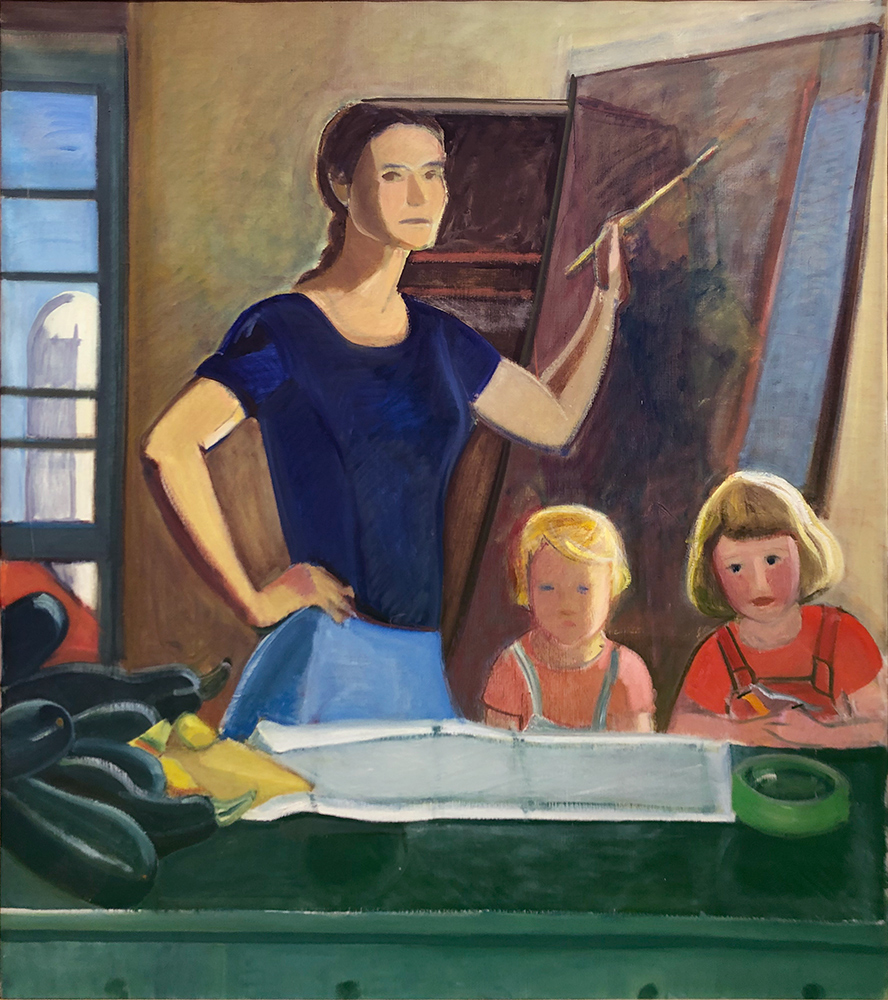
Self-Portrait with Ulla and Melkorka
1983, oil/canvas, 52 x 46 in.
Temma Bell
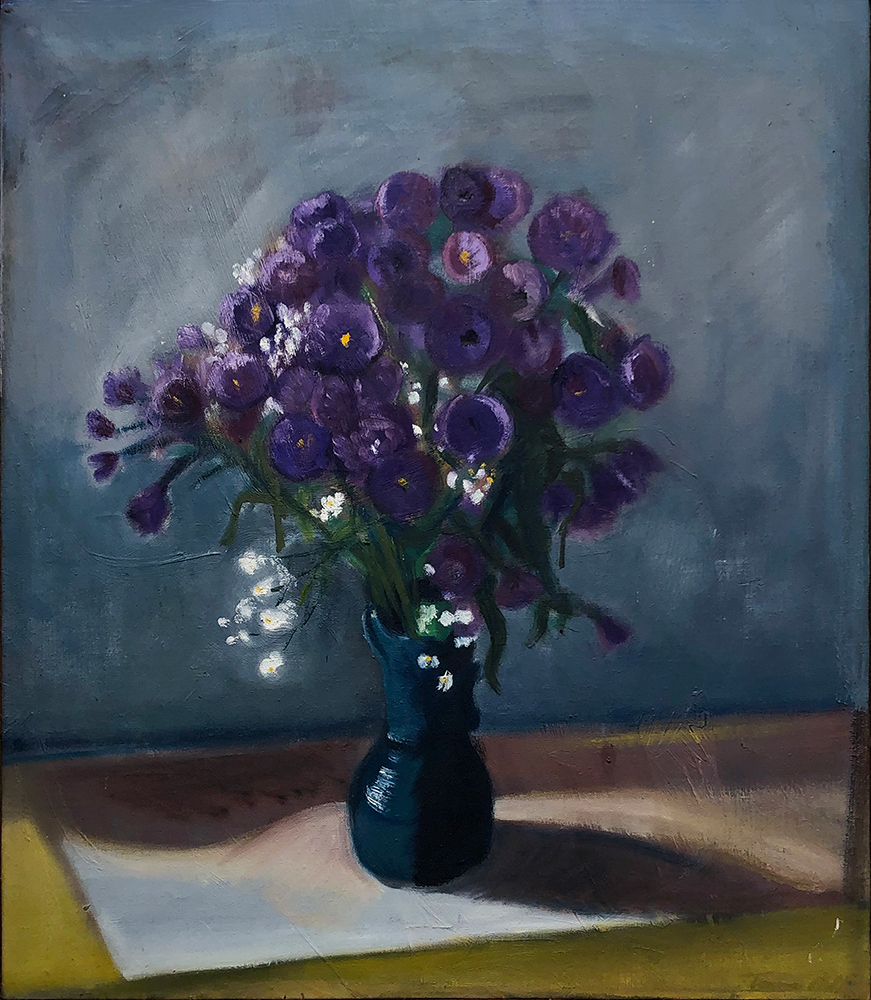
Ulla’s Bouquet of Asters
c.1988, oil/canvas, 22 x 19 in.
Temma Bell
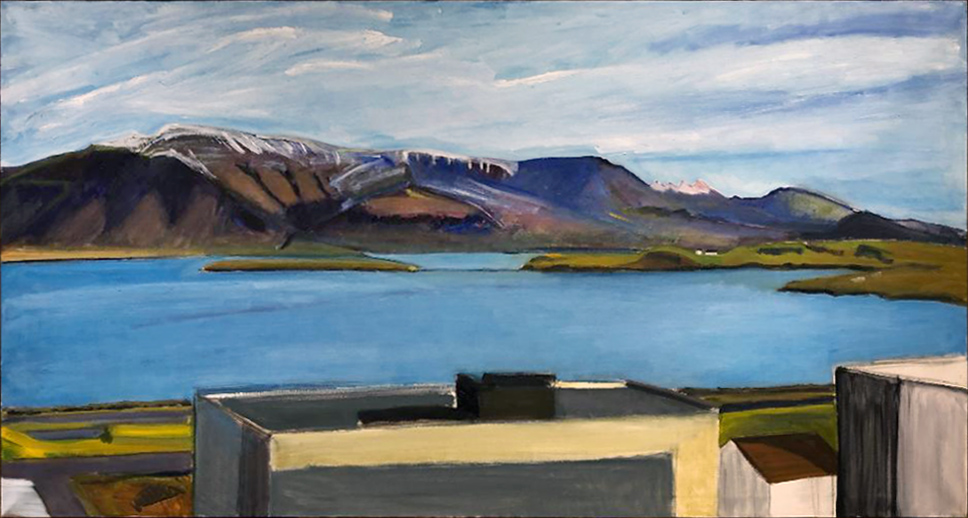
Esjan, into the Fjord
2002, oil/canvas, 32 x 60 n.
Not to be missed this season is the remarkable selection of paintings by Temma Bell at Bowery Gallery. This survey exhibition, handsomely curated by the artist’s daughter Ulla Kjarval, includes 27 paintings dating from 1970 to the present, most depicting the landscape surrounding her upstate farmhouse and its interior rooms, which are usually occupied by family members and pets. Installed in approximately chronological order, the canvases serve as vivid testimony to a life in painting, and also to the impact of family on such a life. (By way of disclosure, I’ll note that as a fellow member of Bowery I have known the artist for many years.)
All the paintings feature the artist’s signature attack of heightened, brushily planar color. While not conventionally naturalistic, the scenes seem to have been produced through the most natural of means; freely painted, without apparent agonizing or hesitation, they rely on color and economical details to locate and characterize her motif.
This faith in the powers of color and line is not misplaced. A superb colorist, Bell (b.1945) re-creates the effects of natural lightfall, using that peculiar power of pigments to generate internal light. The energies of light and composition appear to meld in these paintings, with colors giving weight to light, and pressurizing intervals and depths. All of which is to say that she defines the elements in her paintings not through academic finesse but as unfolding events within an arabesque. Within these modernism-inflected terms, the results feel vibrantly real.
Entering the gallery, the painting that first greets the eye is “Self-Portrait with Ulla and Melkorka” (1983), depicting the artist at work in an interior. One initially absorbs it from nearly twenty feet away on a wall facing the entrance, but as for the works of the best colorists, its forms read forcefully from a distance. The artist’s two oldest daughters are caught in the foreground’s bright illumination, portions of their hair brilliantly lit, their shadowed faces turning a deep, mellow ruddiness. The artist’s own likeness stands behind, enveloped in the slightly dimmer depths of the interior. To one side, the sunlight-carved forms of a silo appear framed in the window, distantly echoing (in gesture) the figures’ poses, and (in its coloration) the light on the girls’ hair. At the bottom, a table’s dark greens cuts horizontally across, serving as both introduction and launchpad for the verticals behind.
The painting melds all the energies of the artist’s work: the overarching allegiance to the workings of light; their translation into the workings of pigments; the locating of details within a circulation of color pressures. Depths resonate, gestures resound. Relying hardly at all on linear perspective or academic modeling, the artist arrives at a vitally real image. (It is crucial to experience the actions of color in the flesh; reproductions on paper or screen won’t convey their vigor.)
The deft installation brings out the range of Bell’s work. Next to this painting hangs “Ulla’s Bouquet of Asters” (c.1988), the “simple” image of a table with a vase of purple flowers. The thought of Ulla’s providing this small canvas' subject matter, and then, forty years later, its display is touching – but the painting rewards in other ways, too. Its somewhat tighter, Impressionistic style makes it one of more conventionally realistic works in the show, but it offers more than the lush atmospherics of a bouquet by Monet or Fantin-Latour. Here, the optical becomes at once physical and motile. One feels, tangibly, the breadth of the bouquet, its lifting above the table’s surface, and the suddenness of the tiny white flowers springing from the vase.
Hanging on an opposite wall is the show’s only sizable landscape produced in Iceland, where the artist (whose mother was Icelandic) has often stayed and painted. The hues of “Esjan, into the Fjord” (2002), are especially exuberant; even gallery-goers unmoved by orchestrations of color may find themselves pausing before it. Compositionally, the painting is divided almost equally into four horizontal bands, but drawing and color put each at vibrant odds with the next. Above, a band of mountains, craggily modelled in sunlight, hums beneath feathery clouds. The lowest band responds with a procession of buildings – prismatically rendered in light, measuring out the canvas’ width. Between these extremes stretches the luminous expanse of the bay. Colors not only charge each movement, but add to the urgency of scale – revealing, for instance, how a small, dark shed, condensed on the factory’s broad roof, becomes the briefest pause before the roof yields to the water’s breadth. Neither drawing nor color contains the other; they proceed together, in lively contention.
Not every painting is as climactic as "Esjan," but wandering through the gallery one senses the artist responding newly and empathetically to every scenario, as if driven to capture this moment, revealed in this light. Upon closer viewing, complications multiply. In “Ingimundur and Temma” (1977), a series of small arcs – a wire-back chair, a watering can’s handle, a grooming cat’s back – pace the intervals between the two figures. In the bottom corner of “Green Fields Warwick,” (1988) the small curling white of a sheep converses, across sweeping seas of green, with the painting’s other brightest light: a two-story house, rendering almost as tiny by its distance.
Among my favorite works is “Winter Still Life” (2006). The painting could be a study in whites: whites of tablecloth, towel, bowl and plates on the table, and a snow-covered field glimpsed through a window. Yet the painting feels fully colorful; each is a different white, and everything sorts out, lucidly: lip of bowl lifts above tablecloth, towel’s diagonal sets the tabletop’s back corner in place, tiny white glints on a silver creamer hold the front corner. Mischievously, a cherry’s miniscule stem restrains – for a millisecond – the towel’s drive into the depths.
Interestingly, all these events have more visual impact than the dimensions of the table that almost fills the painting’s lower half. This, however, is only in accordance with the scene’s actual optics. After all, the sturdiest of objects doesn't necessarily present with with the heftiest set of photons. As if honoring J.M.W. Turner’s dictum, Bell paints what she sees, not what she knows – and the table feels not just real, but doubly so: inhabiting a truthful context.
And this optical context allows for its own dramas. Squared up in the center of the window view, a dark horse grazes in the snow-white field. Though made tiny by its remoteness, it gathers our attention like a target’s inner circle. Below, a mere foot or so away in canvas-inches, but in real-life a couple hundred feet nearer, two blandly textured squashes dip and curl in indulgent response. Shift to a point a foot lower still, and the two silver creamers – truly (in real life!) miniature, their surfaces fractured by reflections and highlights – reside in a different world, in some ways as far distant as the horse. Such are the vagaries of our environment, as absorbed by the unpresuming eye, faithfully remade by an artist delighting more in the wonder of light than the prescriptions of the academy.
What, after all, is “real” in painting? Temma Bell’s paintings remind us that all any painting can do is conjure an equivalent version of the real. Her work shows how the most compelling versions may arise when one sees the familiar world keenly, and draws upon the irreducible powers of pigments spread about a rectangle. Sometimes, the elemental yields the resplendent.
The exhibition remains on view through May 16, 2026
Bowery Gallery
547 W 27 St, Suite 508, New York NY
10001
646.230.6655 · www.bowerygallery.org
back