Bridgehampton Museum: Bruce Lieberman: Paintings March 14 - April 11, 2026 back
Bruce Lieberman
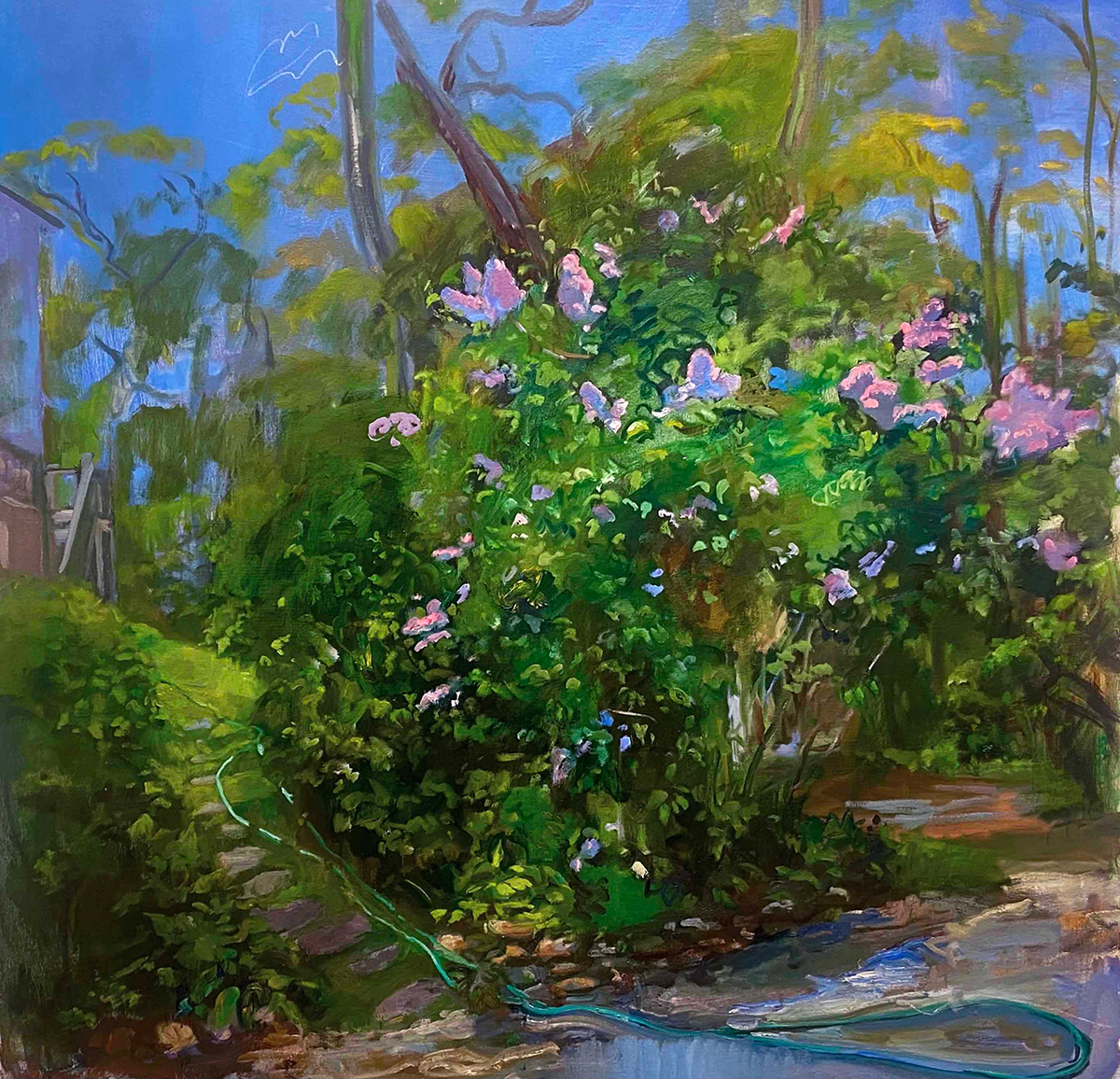
Lilac and Hose
2022, oil on canvas, 48 x 48 in.
Some landscape painting impresses for its facile technique and evocative subject matter. Bruce Lieberman’s paintings, currently on view at the Bridgehampton Museum, possess something rarer: an awareness of great traditional painting, and how deeply it characterizes the visible world through means unique to painting. At a glance, Lieberman’s landscapes afford the spatial dramas, the dazzle of sunlight, and the exuberance of nature’s textures and hues that inspired the Impressionists. But if Impressionism embraced a whiff of escapism – seductive trips to resplendent scenes – Lieberman is clearly more interesting in engaging than escaping. His markmaking has the assurance and probing quality of Ab-Ex: visually, branches are vectors, clouds are gestures. The movements fill and ricochet within the canvas’s rectangle with almost preternatural vigor. The joyous sentiments of Impressionism are there, but charged with something like Cézanne’s compulsion to weight events through pictorial means, to “make something permanent out of Impressionism.”
A native long Islander, Lieberman (b. 1958) fell as a young man under the spell of the figurative New York painters that ascended in the wake of Abstract-Expressionism. Chief among these influences was the painter Paul Georges, whose figurative paintings updated, with raw and occasionally humorous effect, the heroism of the master painters.
Lieberman’s comprehensive pursuit of nature varies from tiny 5 x 7 in. sketches to nine-foot- wide panoramas and larger-than-life (yet strangely intimate) views of corners of gardens. Georges’ inspiring influence shows throughout these works; one experiences sunlight as a pictorial force, its weight rendered in pigments to characterize each note, from a bush’s interior shadowiness to a shrub’s sunlit bulk to a trunk’s slender division of a remote sky.
A painting like “Roses, Umbrella, and Window” (2026) appeals for the sheer effervescence of its many, varied blooming flowers. But even more moving are the muscular rhythms that capture the massiveness of a central bush, and the way that secondary elements – foreground shrubs, building façade – pay homage as they curl around it at top and bottom.
In somewhat similar fashion, “Lilacs and Hose” (2022) plants at its center a flowering shrub, radiant but weighty. Details of pathway, grass, and sky circulate all around, each in its own time. A garden hose, curving around the foot of the lilac, delicately anchors the entire bush; its self-generated role feels, somehow, utterly natural.
In another room, three smaller paintings strike a very different tone. All describe winter forest scenes, using a palette of muted silvery grays and burnt siennas. In each, the air feels saturated by organic growth as multiple trunks wind upwards. Details, though, make each unique: yellow notes of distant fields, the purple-blue body panel of a nearby car, or most dramatically, horizontal bands of brilliantly sunlit snow, setting off the rise of the trees. Like all the paintings, these are really tapestries of color-marks that turn before the eye into familiar but invigorated scenes. They’re clearly propelled not by aesthetic needs, but by an appetite (not so unlike Courbet’s) for the purely visual, whether manifesting as a majestic tree, a swing set, or a car’s hood.
The six-foot-tall painting “Big Sun” (n.d.) features a larger than life-size portrait of a sunflower, whose stem periodically sprouts leaves, muscularly pacing out the height of the flower staring down from above. Meanwhile, far below – practically enclosing our own feet - dots of orange-red and pink flowers stir in the shadowy depths.
The peculiar urgency of these works – of Impressionist motifs supercharged with the gestural immediacy of the NY School – is nowhere more apparent than in “Big Road” (2017). Filling the width of this the nine-foot-wide painting, a procession of churning off-vertical tree trunks is more loosely rendered than any other passage in the exhibition, bringing to mind Pollock’s early break-through painting, “Mural” (1953). And yet, the essentials of an observed world remain, in the palpable movement between shadowed foreground, sunlit fields glimpsed between trees, and the remote fringe of sky.
The exhibition includes a couple older paintings from the early 1990’s with more conspicuously geometric compositions. These, however, reflect the same appealing indifference to conventional taste. “Big F**king Tree” (1991) places a leafless tree dead center, bookended by the harsh forms of sunlit buildings – or rather, diagonal portions of them intruding from the painting’s edges. “Tree and Swing Babylon” (1991-93) compresses a swingset, tree and fragments of buildings into a sharp-angled arena that by all odds should feel obstruse and cramped. But the vivaciously sunlit surfaces make it surprisingly spacious. Here, as in the later paintings, we sense the triumph of pictorial virtue over aesthetic convention – of the random allures of visual experience made luminously purposeful.
at the bridgehampton Museum
2539 Montauk Highway, Bridgehampton, NY 19132
631-537-1088 · www.bridgehamptonmuseum.org back